3 min readTuesday, June 30, 2026·up to 15 members voting
Published briefingOfficial record and source links included
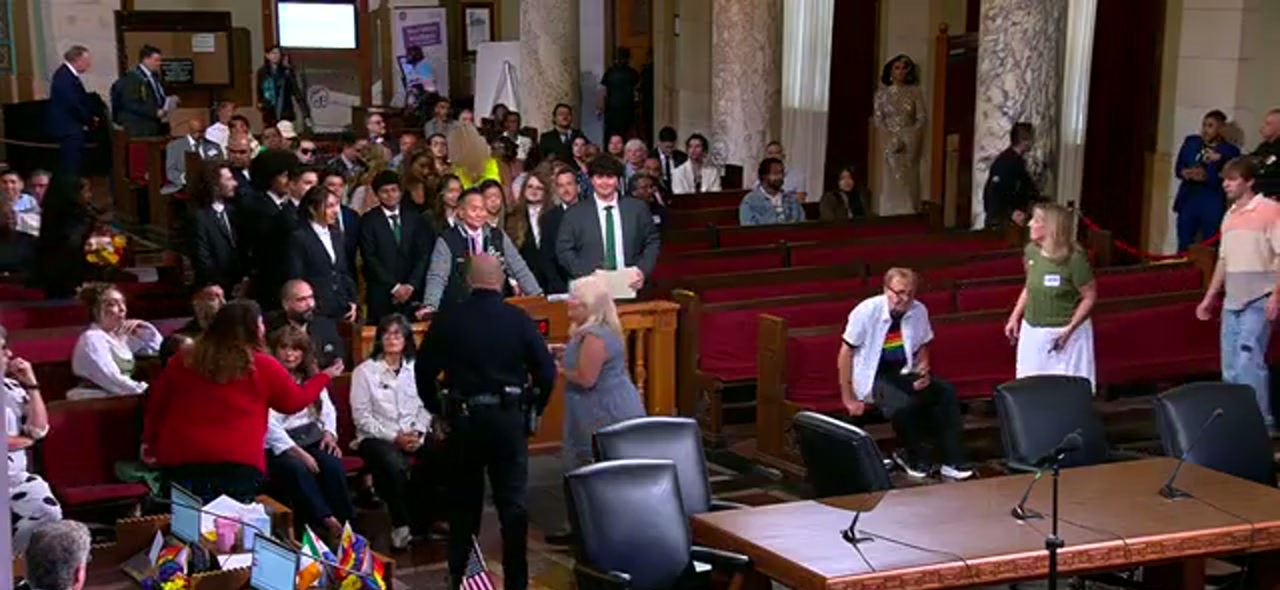
The Council closed June with a long, crowded agenda: routine leases and grants, a public-comment block stretching from downtown housing to fast-food worker protections, and a late cluster of proposed November charter amendments covering planning, ethics, police governance and voting rules.
The city attorney announced that items 1 through 32, item 36, items 63 through 80, and items 82 through 100 were open for comment. Speakers quickly moved between downtown development, election rules, LAPD reform, labor protections, air-quality response and general access to the chamber.
Fourth and Central, worker rules and public health recur
Commenters returned several times to the Fourth and Central project, fast-food fair-work rules, and the air purifier and N95-mask response for communities east of downtown. The testimony made the meeting feel less like one debate than several overlapping pressure points competing for floor time.
The Council recesses for a litigation-risk closed session
The regular meeting recessed into a special meeting called by the Council President. The posted item, CF 26-1100-S17, allowed closed-session discussion of a written threat of litigation from the Los Angeles Police Protective League connected to a proposed LAPD charter amendment.
Ballot-measure files become the center of the meeting
The agenda's late section included proposed November 2026 charter amendments on infrastructure and contracting, City Planning, ethics and governance, voter eligibility, Recreation and Parks funding, proprietary departments, LAPD governance, LAUSD voter eligibility, and LAUSD campaign-finance rules.
A second closed-session item comes before adjournment
The Council also took up a closed-session item in the regular agenda, CF 26-0418, involving the J.M. v. Majano case over a 2023 crash at Whittier Boulevard and Orme Avenue. After the special and closed-session work, the meeting returned to motions and adjournments.
Public Comment Quotes
"Our clients do not have 72 months to wait for each project in this city to deliver affordable housing units."
Jed Leano · Inner City Law Center · auto-caption transcript
"This project would bring over a thousand affordable housing units to the area that is deeply needed."
Public speaker · Fourth and Central / housing comment · auto-caption transcript
"The city of Los Angeles is home to 1.35 million immigrants."
Public speaker · voter eligibility / immigrant community comment · auto-caption transcript
"We have a systems problem. There's not enough affordable housing."
Public speaker · homelessness and housing comment · auto-caption transcript
Agenda Items
ITEMS 91-99Proposed November 2026 charter amendmentsBallot filesThe agenda grouped nine City Attorney ordinance and ballot-resolution files covering infrastructure and contracting, planning, ethics, voter eligibility, Recreation and Parks funding, proprietary departments, LAPD governance, LAUSD voter eligibility and LAUSD campaign finance.
SPECIALLAPPL litigation-risk closed sessionClosed sessionThe special agenda allowed Council to confer with legal counsel about a written litigation threat from the Los Angeles Police Protective League tied to CF 26-1100-S17.
ITEM 100J.M. v. Majano litigation matterClosed sessionThe regular agenda included a separate closed-session item involving a March 2023 motorcycle and pedestrian crash at Whittier Boulevard and Orme Avenue.
ITEM 82Building and Safety fee adjustmentsReportThe Department of Building and Safety fee item estimated roughly $42 million in annual Enterprise Fund revenue from proposed permit and service fee changes, with additional fee work still to come.
ITEM 83Telephonic access disruption policyPolicyA City Attorney report proposed procedures for recessing and reconvening Council meetings when public-comment phone access is disrupted.
ITEMS 1-31Leases, grants, appointments, public works and housing filesMixed actionsThe front of the agenda included Human Relations appointments, aging-program updates, public works matters, leases, CalVIP grant funding, housing allocations, and continued items from prior meetings.
What Happens Next
The charter files are the ones to watch: if they continue through the election process, voters could see multiple City Charter questions on the November 3, 2026 ballot. The LAPD governance measure also carries litigation risk flagged by the special agenda. Several ordinary funding and lease items move into implementation, while telephonic-access rules and Building and Safety fee changes set up follow-up administrative work.
Three-minute briefing complete
Go deeper on the decisions
The extended report separates the routine agenda from the public-comment pressure points and the charter-reform package that dominated the late meeting.
Continue · 6 min ↓Extended report open ↑
Extended report · 6 min
A regular meeting became a ballot-measure staging ground
June 30 looked at first like an end-of-month cleanup agenda. By the time public comment and closed-session work were done, the meeting had become a preview of the city's next fight over how Los Angeles governs itself.
The key distinction
The public agenda did not simply list one charter proposal. It placed a package of separate ballot-measure files before Council, including police governance and voter eligibility questions that drew immediate public attention.
1 · Public comment
The comment period showed how much was packed into one meeting
Speakers used the wide comment window to address downtown housing, charter reform, LAPD accountability, immigrant voting questions, fast-food worker protections, and the city's response to smoke and ash impacts east of downtown. The comments did not converge on one item; they mapped how many major policy tracks had been stacked onto the same day.
Housing and development
Several speakers supported Fourth and Central and argued Los Angeles cannot wait years for housing production.
Governance and voting
Other speakers focused on charter amendments, LAPD oversight, election eligibility, and whether voters should be asked to change the city's governing document.
2 · Closed session
The LAPD charter file carried legal risk before the public debate was over
The special meeting was called for one closed-session item: a written threat of litigation by the Los Angeles Police Protective League over CF 26-1100-S17. That file corresponds to the LAPD-related charter amendment on the regular agenda. The procedural move matters because it shows the proposal was already legally contested while Council was still positioning it for the ballot process.
3 · The charter package
The agenda put multiple city-structure questions in motion
91Infrastructure, budget, finance and contractingBallot file
92Los Angeles Department of City PlanningBallot file
93Ethics, elections and governanceBallot file
94 / 98Voter eligibility rules for city and LAUSD electionsBallot files
97Los Angeles Police Department governanceBallot file
4 · Ordinary business
The rest of the agenda still moved city operations
Outside the charter files, Council had items on Human Relations appointments, aging-program planning, public works, leases, CalVIP grant funds, housing allocations, Building and Safety fees, MyLA311 configuration, metal theft, firearm technology, animal cruelty procedures and network modernization. The breadth is part of the story: routine administration and constitutional-scale reform were sharing the same meeting.
5 · What to watch
The ballot calendar is now the pressure point
The proposed charter amendments are written for the November 3, 2026 election. The next question is which measures survive the legal, political and procedural steps between agenda posting and actual ballot placement. The LAPD measure deserves special attention because it was also the subject of the special closed-session litigation-risk item.
Sources and method: This extended report uses the official meeting recording, PrimeGov agenda files, special agenda, and the YouTube auto-caption transcript saved with this meeting's source package. Speaker names and quotes should be treated as auto-caption-based until replaced with a human-verified transcript.
Sources:Watch full recording ·
Official agenda ·
Special agenda ·
Official agenda record.
Timeline markers are positions in the official recording. This briefing is built from official agenda material and YouTube auto captions; quotes should be checked against a human transcript before being treated as final.