Special report / Mayor's race
The Sherman Oaks test
Two former allies walked into a 90-minute Sherman Oaks debate with different answers to the same problem: who can make Los Angeles deliver?
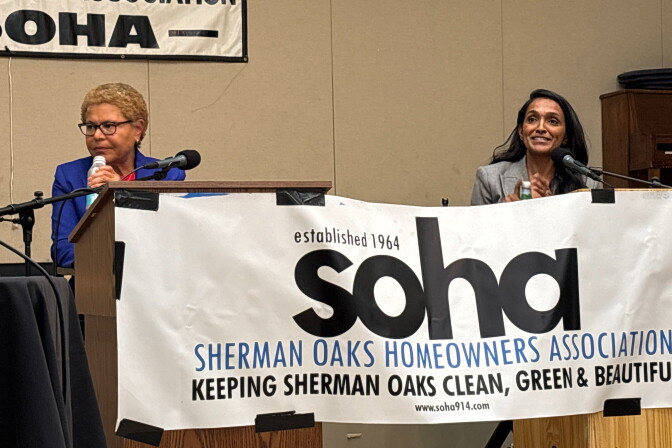
WhenAug 19, 2026
WhereSherman Oaks
Format90-minute debate
The sharpest disagreement was not simply left versus center. It was a disagreement about where accountability lives: in the mayor's office, or in the systems the city has to audit, staff and repair.
01 / The scoreboard
One night, four numbers did most of the talking.
The candidates used numbers as political proof, but the numbers did different kinds of work. Some described the city's condition. Others described a program's reach. The debate's central problem was that these measures are not interchangeable.
Estimated people experiencing homelessness in the 2026 Greater Los Angeles Homeless Count.
+3.4% citywideThe debate centered on the first increase after two years of citywide declines.
2025 to 2026Raman cited a decrease in unsheltered homelessness in the district that includes Sherman Oaks.
Raman's recordA Los Angeles Times analysis cited by coverage found this share of participants later returned to homelessness.
Program churnSources: LAist debate recap and City News Service recap. Figures are reported claims and should not be read as a like-for-like performance score.
02 / The real split
Bass offered a chain of command. Raman offered a chain of custody.
Bass's answer to dysfunction was consolidation: if the city controlled the homelessness system more fully, it could contract directly for health, mental-health and substance-use services. Raman's answer was verification: audit city spending, staff oversight and track whether programs deliver.
Put the system in one set of hands.
The mayor argued that the current city, county and LAHSA structure is fragmented. Her theory is that clearer authority makes it easier to act, coordinate care and own the result.
Make every dollar answerable.
Raman promised a first-six-month audit of homelessness spending and a fully staffed Bureau of Homelessness Oversight. Her theory is that authority without measurement can simply move failure around.
The debate was a fight over the verb “deliver”: who gets to say a program worked, and what evidence would make that claim credible?
03 / Four fault lines
The candidates were arguing about the same city from different levers.
Across the debate, Bass spoke from the mayor's executive perch. Raman spoke from the council's oversight and budgeting perch. That difference shaped every answer, including the moments when each candidate blamed the other for a shared system.
Move toward stronger city control and direct health-service contracts.
Audit every city dollar, staff oversight and track outcomes over time.
Oppose Sacramento-directed density and point to 42,000 units in the pipeline.
Support SB 79 in a moderated form and push the Planning Department to build.
Defend police hiring and the contract raises as necessary for recruitment and retention.
Support maintaining department size while tying police costs to the rest of the city budget.
Point to an appointed liaison and existing city advocacy for the industry.
Seek a larger California incentive modeled on Georgia and New Jersey.
04 / What the numbers cannot settle
The debate produced competing explanations, not a single verdict.
Raman's district result is politically potent because it gives her a local proof point in a citywide race. Bass's Inside Safe argument is politically potent because it gives an incumbent a program she can point to. Neither number, alone, establishes causation or tells voters what happens next.
The bars are editorial annotations, not polling or performance scores. They visualize the kinds of evidence each campaign emphasized.
05 / Watch the room
The full debate is most revealing when the roles reverse.
When Bass criticized Raman for six years at City Hall, the mayor turned council tenure into a test of responsibility. When Raman criticized Bass for streetlights, potholes, sanitation and the police contract, the challenger turned executive power into a test of results. The strongest moments were the ones where both claims could be true at once.
Not who won the exchange, but which candidate can publish a credible chain from money to service to outcome.